Razer Tartarus V2 Pro: The $200 Half-Keyboard That Finally Fixed Its Thumbstick
By AS Gaming EditorialNovember 23, 20265 min readPC
Source: Razer (official product art)
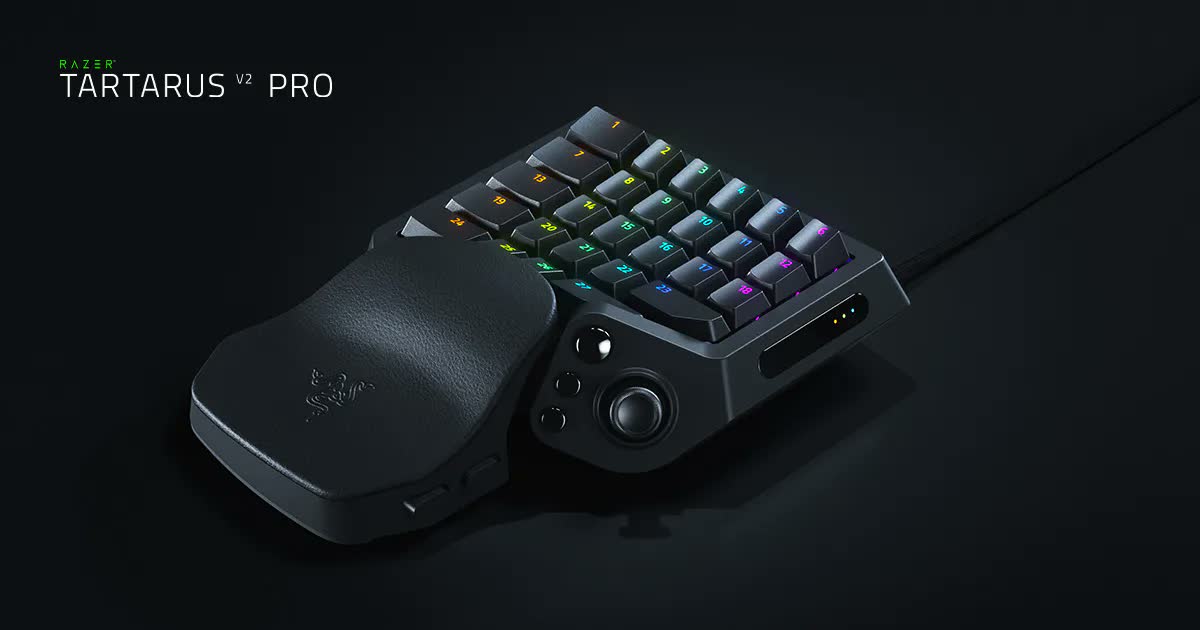
The Razer Tartarus V2 Pro is the weirdest $200 peripheral Razer sells, and after two months on the market it is also one of the easiest to recommend to the right player. The one-handed keypad packs 31 programmable controls, analog optical switches with adjustable actuation and a full-size TMR thumbstick into a wedge built for MMO and MOBA players who live on keybinds. An October firmware update fixed its biggest launch flaw, which is the main reason this is worth writing about now. Razer's official product page is at razer.com.
Thirty-one controls under one hand
The Tartarus V2 Pro gives your left hand 27 analog keys, a thumbstick and three dedicated thumb buttons, all arranged around a WASD cluster that feels familiar within minutes. The keys wear textured doubleshot PBT caps that resist shine, the body curves to fit the palm, and the wrist rest slides back and forth and pivots left and right, so it adapts to different hand sizes and forearm angles instead of forcing your wrist straight. Chroma RGB runs through the whole thing, it connects over a detachable USB-C cable, and Synapse stores up to 24 keymaps across three onboard profiles, so your layouts travel with the device.
The point of the shape is desk space. Slicing away the right side of a keyboard clears a huge area for mouse movement, which is exactly what low-sensitivity players want, and it puts every command you actually use under one hand. MMOs and MOBAs are the obvious targets, but anything with a big keybind list works.
The switches are the real story
Under the keycaps sit Razer Analog Optical Switch Gen-2 hardware, and this is where the V2 Pro earns its price. Actuation is adjustable from 0.1mm to 4.0mm per key, so movement keys can trigger at a hair-trigger 1.0mm while an emergency shield or grenade toss can demand a full press to prevent costly accidents. Rapid Trigger resets the switch the instant it starts moving back up, even by 0.1mm, instead of waiting for a fixed reset point. The switches are rated for 100 million clicks and are immune to magnetic interference.
The input suite goes further: Snap Tap prioritises the newest keypress between two opposing directions, Snap Flex triggers commands on key release, Dynamic Keystroke changes what a key does mid-press, and Dual-Keypress Priority sorts out simultaneous inputs. Polling runs at 8000Hz over HyperPolling. Most players will never feel the difference between 1000Hz and 8000Hz, but the adjustable actuation is genuinely useful from the first session, and that is the feature that justifies the keypad.
The thumbstick, fixed (mostly)
The thumbstick was the V2 Pro's boldest gamble and its biggest launch flaw. Older Tartarus models used a clicky directional pad; the V2 Pro swaps in a full-size Tunnel Magnetoresistance thumbstick with three swappable caps (short concave, long concave and short convex dome), plus three side buttons for jumps, crouches and voice toggles. At launch, though, the stick worked as an eight-way or four-way directional input rather than a true 360-degree analog stick, which undercut the whole idea.
Razer has been patching it since. A firmware update on October 19, 2026 added thumbstick orientation options and the choice to replicate a controller's left stick instead of the default right stick, and Windows Central's updated review found the post-patch stick much more viable. Native analog stick emulation is still promised in a future update, so the stick is better than it was but not yet finished. That is the honest state of it: fixed enough to recommend, with one more patch still owed.
Who should actually buy it
The price is the first filter. At $199.99, the Tartarus V2 Pro costs as much as some premium full-size keyboards, and it is a specialist device, not a smaller replacement for a normal keyboard. The original Tartarus launched at $79.99 in 2013 and the Tartarus Pro arrived at $129.99 in 2019, so the price has climbed a long way. Against that, you get the best analog switches Razer makes, a wrist rest that actually adjusts, and a keypad that reviewers keep praising for comfort and customization.
Buy it if you play MMOs or MOBAs with a big keybind list, if your desk is cramped, or if you have always wanted a dedicated left-hand controller. Skip it if you want a normal keyboard, or if you need deep physical customization of the layout itself: Azeron's competing keypads offer considerably more of that. If you are already in Razer's ecosystem, our Raiju V3 Pro Signature Edition and carbon fiber Viper V4 Pro coverage shows the same design language at work. For the right player, the Tartarus V2 Pro is the rare half-keyboard that earns its desk space.