Philips Evnia 27M2D5901A: A 5K 180Hz Monitor That Drops to QHD 350Hz for £699
By AS Gaming EditorialNovember 15, 20265 min readPC
Source: Philips Evnia (official product image)
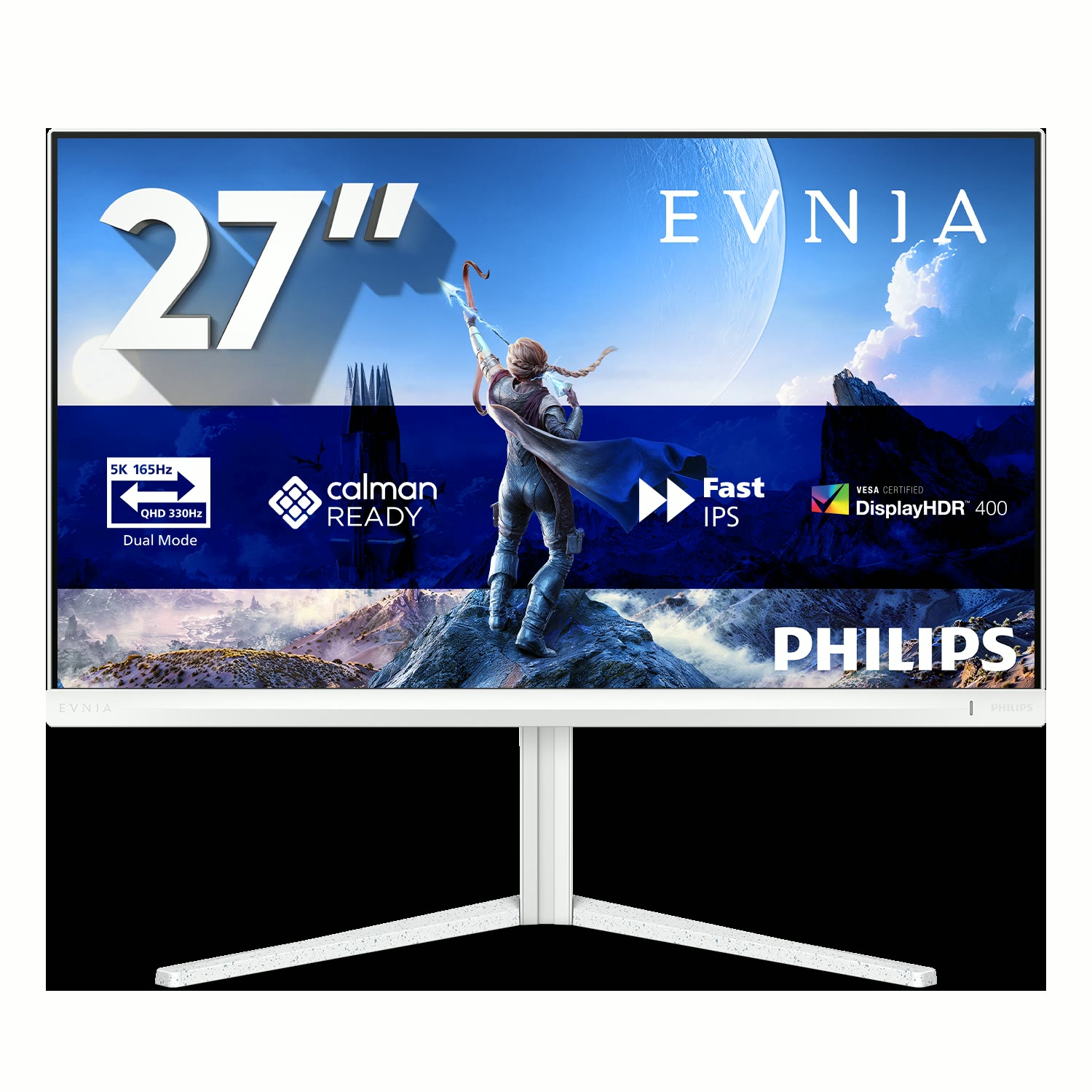
The Philips Evnia 27M2D5901A is a monitor with two personalities, and Philips finally put a price and a date on it. The 27-inch dual-mode gaming monitor launches in the UK in December 2026 for £699, with Germany and Austria getting it in late November or early December for €929. It was first shown at a press event in Dubrovnik back in April, when Philips talked about a July release and a €799 price. Both slipped. The December launch is the real one.
The idea is simple: one screen that is sharp enough for story games and fast enough for competitive ones, without asking you to buy two monitors or compromise on either.
Philips Evnia 27M2D5901A: Two Monitors in One
In its native mode, the 27M2D5901A runs at 5120 x 2880, a 5K resolution, at 165Hz, overclockable to 180Hz. On a 27-inch panel that works out to about 218 pixels per inch. For comparison, a 27-inch 4K screen sits at around 163 PPI, so the Evnia packs in 77 percent more pixels than a standard 4K display of the same size. Text is crisper, fine detail in open-world games is cleaner, and there is more screen real estate for work when you are not gaming.
Flip to dual mode and the panel drops to QHD, 2560 x 1440, while the refresh rate jumps to 330Hz, overclockable to 350Hz. That is the mode for shooters and competitive games, where motion clarity and responsiveness matter more than pixel density. The switch is a button press, not a settings dive, which is the whole point: you change the monitor to match the game, not the other way around.
Both modes run on a Fast IPS panel with a claimed 1ms grey-to-grey response time. Philips quotes the usual caveats around that figure, and independent testing will need to confirm real-world motion performance, but on paper the panel covers both jobs.
The Rest of the Spec Sheet
The monitor carries VESA DisplayHDR 400 certification and supports HDR10, with 1.07 billion colors and 98 percent DCI-P3 coverage listed on Philips' product page. Ambiglow lighting, now with the AmbiScape ambient system, throws a glow behind the panel that matches what is on screen.
Connectivity is strong: two HDMI 2.1 ports, a DisplayPort input, and USB-C with DisplayPort Alt Mode, data, and up to 96W of power delivery, enough to charge a laptop over a single cable. A built-in KVM switch lets two computers share one keyboard and mouse, which matters for anyone running a gaming PC and a work laptop off the same desk.
One discrepancy to note: some sources list the DisplayPort input as 2.1 with UHBR20 support, while Philips' own product page lists DisplayPort 1.4 in places. Philips will need to clarify that before launch, because it matters for anyone planning to drive 5K at 180Hz. Club386's report and the official Philips product page both confirm the core specs and the December date.
The Catch: You Need a Serious GPU
A 5K panel at 165 to 180Hz is a major challenge for graphics hardware. Philips says so itself. Running demanding games at 5120 x 2880 and high refresh rates needs a top-end GPU, and that adds cost well beyond the monitor. If your card cannot feed it, you will spend most of your time in QHD mode, which is fine, but then you paid for pixels you are not using.
HDR is the other honest limitation. DisplayHDR 400 is an entry-level certification, not an OLED-class one. It means basic HDR support, not the deep blacks, localized brightness, or contrast that make OLED screens pop. This is a Fast IPS panel, and it will look like one: bright, accurate, and flat in dark scenes compared with the OLED competition.
That comparison is the real question. At £699, the Evnia sits alongside OLED and mini-LED displays that deliver superior contrast and HDR, even though they lack its dual-mode trick. Our best OLED gaming monitors roundup covers the alternatives, and the MSI MAG 256QR36 is a cheaper pure-speed option at 1440p and 360Hz if competitive play is all you care about.
Who Should Buy It
The Evnia 27M2D5901A makes sense for one specific person: someone with a single-monitor desk who plays both cinematic single-player games and competitive shooters, and who has the GPU to drive 5K. For that person, it replaces two purchases with one, and the £699 price is reasonable for what it is: a 5K screen and a 350Hz screen sharing one stand.
It makes less sense if you only play one kind of game. Pure competitive players get more speed per pound elsewhere. Pure single-player fans get better contrast from an OLED at the same price. And if your GPU is mid-range, the 5K mode will sit idle.
Philips has not given an exact December release date, and pricing for other markets is still unconfirmed beyond the UK, German, Austrian, and Swiss figures. But the monitor is real, the price is set, and the dual-mode idea is genuinely useful. Whether it justifies the premium depends on independent testing that does not exist yet, and on whether your graphics card is up to the job. If both check out, this is the most flexible gaming monitor Philips has ever made.