Source: Auroch Digital / Games Workshop (official key art via Steam)
7.5
7.5/10 · Good
Strengths
The Vampire Survivors loop, transplanted faithfully, still hooks hard
Warhammer flavor is genuine, from dice rolls to miniature paints
Cheap entry price and 25-minute runs that respect your time
Weaknesses
Early minutes of every run drag before builds come online
Weapon balance is uneven, with several weak picks
Meta-progression leans on grinding over smart play
How we score: this verdict is our editorial take, based on launch coverage, critical reception and community feedback.
Warhammer Survivors is exactly what the name promises: Vampire Survivors, rebuilt inside the Warhammer universes. Auroch Digital, the studio behind Warhammer 40,000: Boltgun, built it in partnership with poncle, the creator of the original, and the result launched on November 10 for PC, PlayStation 5, Xbox, and Switch at just $7.99. This Warhammer Survivors review weighs whether the crossover earns its place or just coasts on two famous names.
The short version: it earns it, mostly. The core loop is intact, the Warhammer dressing is more than skin deep, and the price makes it an easy recommendation for anyone who likes the genre. But the game also inherits the genre's worst habits, and a few of its own balance problems keep it from the top tier. Critics have landed in roughly the same place, with a Metacritic score of 78 and a generally favorable consensus across the first batch of reviews.
Warhammer Survivors Review: The Loop Still Works
If you know Vampire Survivors, you know this game. You pick a character, you move around an arena, and your weapons fire on their own while you dodge, collect experience, and pick upgrades on every level-up. Enemies pour in by the hundreds, and by the end of a run the screen is a wall of projectiles and damage numbers.
Warhammer Survivors trims the formula slightly. Stages run 25 minutes instead of 30, which sounds minor but changes the rhythm. Runs feel tighter, and the shorter clock means a failed attempt stings less. The trade-off is that builds have less time to reach their chaotic peak, so the truly absurd power spikes arrive later in a run than veterans might expect.
The game also pushes you to think a little harder about positioning. Specialized enemies show up more often, and they force you to weave through the horde instead of standing in one spot and letting the auto-attacks do the work. It is a small change, but it keeps the middle of a run from turning into a screensaver.
The Warhammer Flavor Is the Real Deal
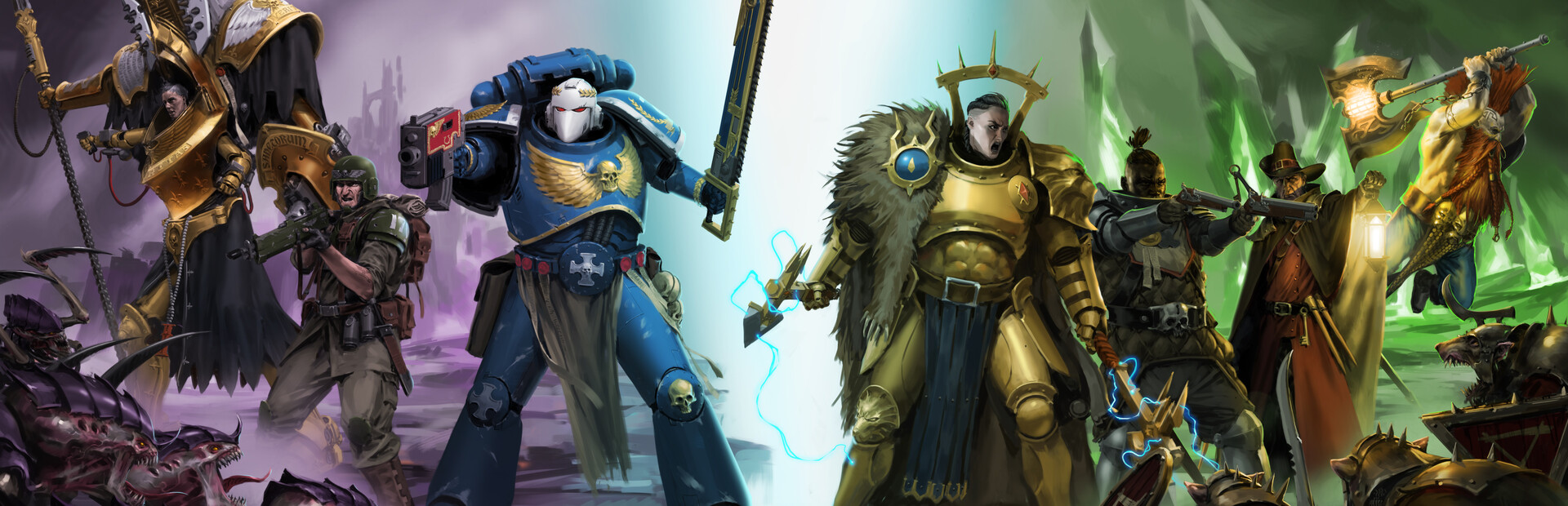
Where the game earns its name is in the details. This is not a palette swap. The two Warhammer universes both show up, with heroes facing Tyranid, Ork, bestial, and Warp-spawned hordes across maps that feel properly grimdark. The writing and art direction treat the source material with obvious affection, and fans will spot references that casual players will walk straight past.
The best touches are the ones that borrow from the tabletop. Playable characters are unlocked by finding miniature figure paints scattered across maps, a nod to the painting side of the hobby. Power-ups can include rolling actual damage dice across the battlefield to crush your foes, and you can drop giant blast radius templates on top of enemies. These are the kind of ideas that only make sense if the team genuinely loves the source material, and they land.
With more than 75 weapons in the game, there is plenty to experiment with, and the roster spans both the far future of Warhammer 40,000 and the fantasy world of Warhammer itself. That breadth gives the game a wider toy box than most survivors-likes manage.
Where It Stumbles
The problems start in the first few minutes of every run. With only a starter weapon at its lowest level, the early game is slow and uninteresting. Waves are light, kills come slowly, and the fun does not really begin until you have a few upgrades under your belt. That is a real cost when a run lasts 25 minutes: the dull opening is a meaningful chunk of every attempt.
Balance is the bigger issue. Some weapons are simply weak, and the gap between a good pick and a bad one is wide. A few attacks hit a small random spot or a handful of enemies, which is useless when you are surrounded by a crowd that grows every minute. The lack of meaningful synergies between weapons makes the problem worse: in the best survivors games, combining the right pieces creates something greater than the sum of its parts, and here those moments are rare.
Meta-progression leans on grinding, too. Success depends heavily on stat increases bought with collected tithe, which means you will fail runs through no fault of your own until you have put in the hours. Push Square praised the adaptation as heartfelt and addictive, while Cubed3 was cooler on it, calling the game forgettable in places and pointing at the same balance and pacing problems. Both views are fair, and which one you land on probably depends on how much patience you have for the genre's grind.
The Verdict
Warhammer Survivors is a faithful, loving crossover that understands both halves of its premise. The loop still hooks, the Warhammer details are genuinely charming, and at $7.99 it is priced to move. But slow starts, uneven weapons, and a grind-heavy progression curve keep it from matching the game it is built on.
If you already love Vampire Survivors and have any affection for Warhammer, buy it. It is more of a good thing, dressed in the best grimdark the genre has seen. If you bounced off survivors games before, this one will not convert you. It is a solid 7.5, and a great companion piece to our Warhammer Survivors beginner guide if you want to survive your first runs. It is also worth noting that Football Manager 27 launched the same week to stronger reviews, so the $7.99 price tag here is doing a lot of the heavy lifting.