MSI MAG OLED 321UPX18: A 4K 180Hz QD-OLED Monitor With a Brighter Tandem Panel
By AS Gaming EditorialNovember 20, 20266 min readPC
Source: MSI (official press image via PR TIMES)
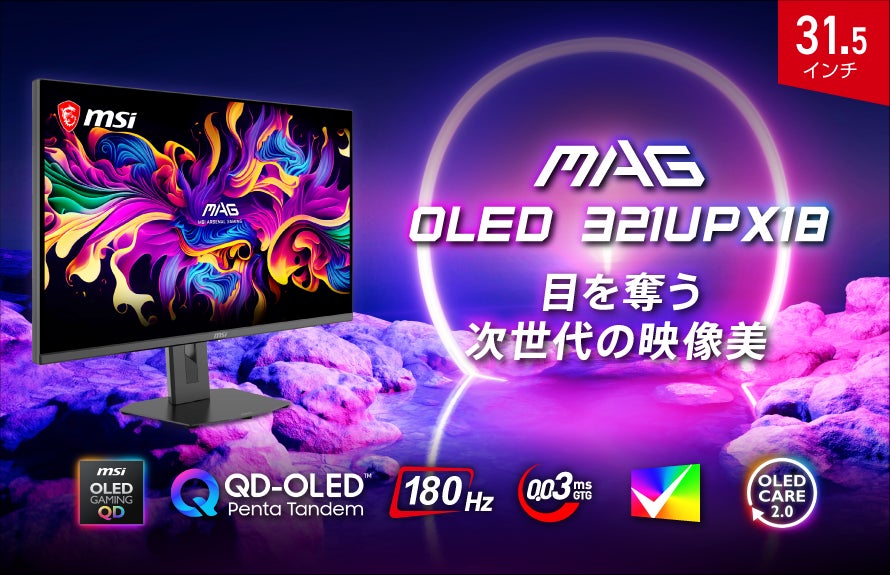
MSI is not waiting for the new year to push OLED monitors forward. The MSI MAG OLED 321UPX18 goes on sale November 26 in Japan, and it is the latest monitor built around Samsung's new five-layer tandem QD-OLED panel, a 31.5-inch 4K screen running at 180Hz with a 0.03ms response time. MSI announced it on November 19, priced at around 123,800 yen, and it lands in a month where every monitor maker seems to have a tandem OLED to show off.
The headline spec is the panel. The MSI MAG OLED 321UPX18 uses a 5-layer tandem QD-OLED structure that MSI says boosts brightness by up to 30 percent over a standard QD-OLED, letting the screen hold peak brightness in HDR for longer while keeping power consumption low. It is the same panel technology behind AOC's new U32G5D, another 31.5-inch 4K 180Hz monitor that launched in China this month, so tandem QD-OLED is quickly becoming the default for premium 4K gaming screens rather than a one-off experiment.
MSI MAG OLED 321UPX18 specs at a glance
The full spec sheet, from MSI's official announcement: a 31.5-inch QD-OLED panel at 4K UHD (3,840 x 2,160), 180Hz refresh rate, 0.03ms grey-to-grey response time, 250 nits typical brightness with a 450-nit peak, a 1,500,000:1 contrast ratio and DisplayHDR True Black 400 certification. Color coverage is 100 percent sRGB, 97 percent Adobe RGB and 99 percent DCI-P3, factory calibrated to a Delta E of 2 or less.
Connectivity covers the bases: two HDMI 2.1 ports, one DisplayPort 1.4a, one USB Type-C with DisplayPort Alt Mode, two USB 3.2 Gen 1 Type-A ports for the built-in hub, a USB Type-B upstream port and a headphone output. The panel is flat, not curved, with a half-glare coating, and the surface hardness has been improved from 2H to 3H, which MSI says makes it 2.5 times more resistant to scratches and scuffs. The stand adjusts for height, tilt and swivel, and the whole unit weighs about 8.1 kg.
What the 5-layer tandem panel actually does
Tandem OLED stacks multiple light-emitting layers on top of each other. In a five-layer design, each layer shares the work, so the panel can push more light without driving any single layer as hard. That is where the brightness gain comes from, and it also helps with longevity, since the layers degrade more slowly when they are not pushed to their limits.
In practice, the numbers here are modest rather than eye-popping. A 450-nit peak is a step up from older QD-OLED monitors, but it is not in the same league as the 1,000-nit peaks on high-end Mini LED screens, and 180Hz is fast without being the 240Hz or 360Hz that competitive players chase. The panel's real strengths are the ones OLED has always had: perfect blacks, a 0.03ms response time with effectively no ghosting, and color that looks rich without calibration. The tandem structure makes those strengths a bit brighter and a bit more durable. It does not turn this into a different kind of monitor.
The 24.5 and 27-inch modes are the real story
The most interesting feature is not the panel at all. The MAG OLED 321UPX18 can shrink its display area to a 24.5-inch or 27-inch window, which is a feature aimed squarely at competitive FPS players. A smaller image means less eye movement across the screen, and on a 31.5-inch panel, a 24.5-inch window puts the whole game inside your central vision.
It is a smart addition, and it tells you who MSI is really selling to: not just the player who wants a big beautiful 4K screen for single-player games, but the competitive player who wants one monitor to do both jobs. Play story games at full 31.5-inch 4K, then switch to a 24.5-inch window for ranked matches. The KVM switch fits the same logic: control two PCs with one keyboard and mouse, with USB devices switching automatically when you change inputs.
Ports, KVM and burn-in protection
Burn-in is the question every OLED buyer asks, and MSI answers it with OLED Care 2.0: panel protection, pixel shifting, still image detection and logo detection, with a panel refresh that runs automatically every 24 hours when the display is off or in standby. Behind the panel, a graphene film and a specially designed heatsink handle cooling without a fan, which matters if your desk sits close to your ears.
The eye-care spec sheet is thorough too: anti-flicker, hardware blue-light reduction and an anti-reflection coating. G-Sync Compatible support is included, along with picture-in-picture and picture-by-picture modes. There is no pivot rotation on the stand, which is a small miss on a monitor at this price, but height, tilt and swivel cover the adjustments most people actually use.
Price, release date and who should wait
The MAG OLED 321UPX18 launches November 26 in Japan at around 123,800 yen, sold through Amazon, with a three-year domestic warranty. MSI has not announced pricing or availability outside Japan yet, so buyers elsewhere are waiting on a global launch date. For context, AOC's rival U32G5D launched in China at around 3,498 yuan, roughly $524, which underlines how much of the MSI price is the Japan launch premium and the MAG branding rather than the panel alone. Our best OLED gaming monitors guide has the wider field if you are shopping now.
Who should buy it: if you are in Japan, want a 31.5-inch 4K OLED and play a mix of story games and competitive shooters, the size modes and the tandem panel make this a strong pick. Who should wait: anyone outside Japan, anyone who wants 240Hz or higher, and anyone whose budget stops short of the launch price. The tandem QD-OLED wave is just starting, and the MSI MAG 256QR36 shows the same company will sell you 360Hz at 1440p for less money if raw speed matters more than 4K. Check the MSI product page for the full spec sheet, and expect global pricing news in the coming weeks.