Keychron Orca Echo Is a Split Keyboard With a Trackball, and Its Kickstarter Is Live
By AS Gaming EditorialNovember 21, 20267 min readPC
Source: Keychron (official product images)
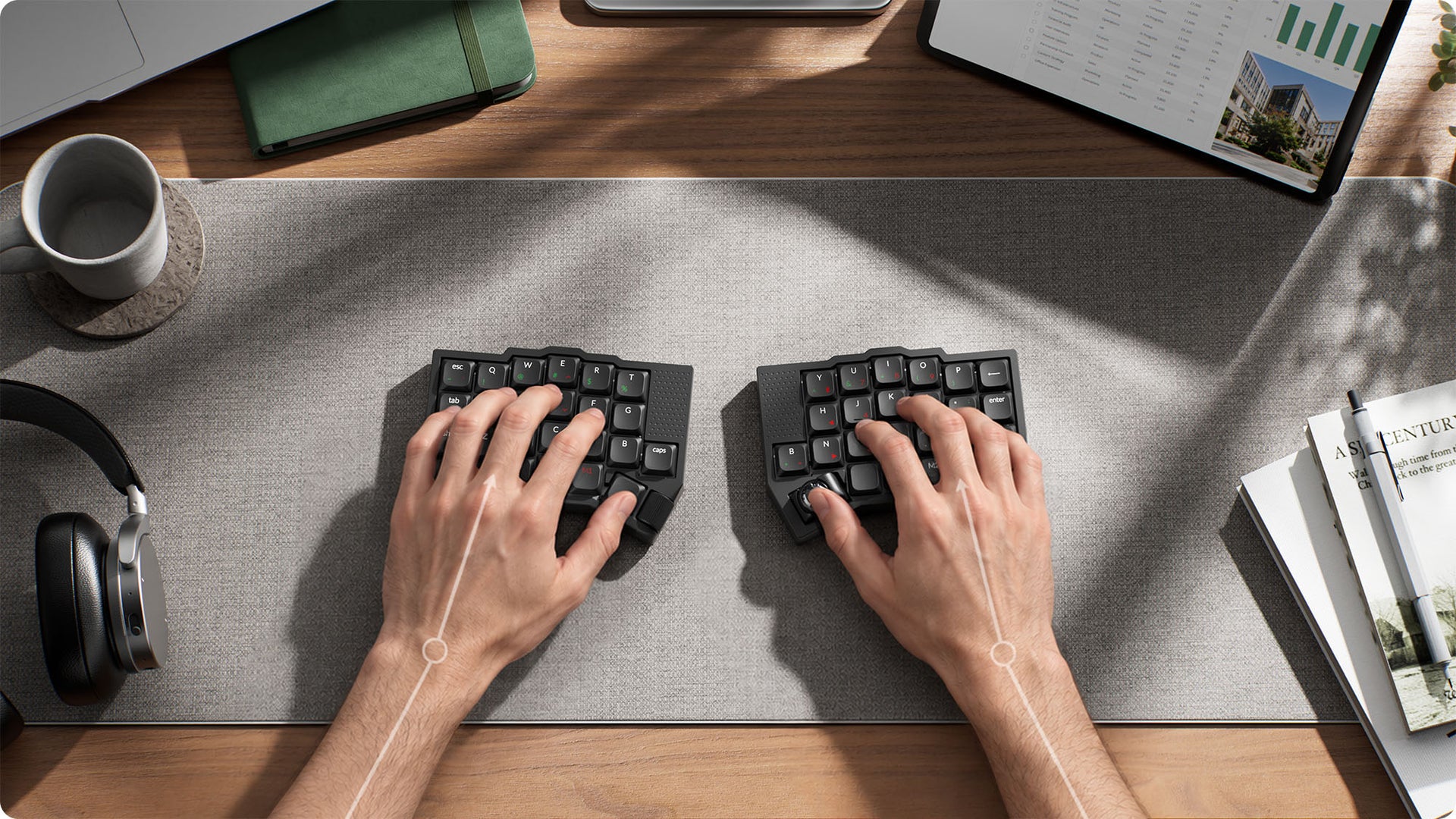
Keychron makes some of the most sensible keyboards in the business, and then, every so often, it makes something gloriously weird. The Keychron Orca Echo is the weird one: a 49-key split ergonomic keyboard with a 19mm trackball built in under your right thumb, a scroll wheel on the left, and touch-sensitive scroll pads on both sides. It launched on Kickstarter globally on November 18, 2026, after a record-breaking run in Japan, and the early-bird price is $158. Shipping starts in March 2027.
This is not a gaming keyboard in the usual sense. There is no rapid trigger, no 8,000Hz polling headline, no esports branding. What it is, is a keyboard for people who spend long hours at a desk and want their hands to stop hurting, without giving up the mouse entirely. That audience overlaps heavily with gamers, because long sessions are long sessions, whatever is on the screen. And the idea behind it is genuinely interesting: if the pointer lives on the keyboard, your right hand never has to leave home row to click something.
Keychron Orca Echo: what you actually get
The Orca Echo splits into two halves, each with 49 keys in a column-staggered layout, which means the keys follow the natural arc of your fingers instead of sitting in straight rows. The right half holds the 19mm trackball under your thumb, plus a roller in the same area. The left half holds a scroll wheel. Both halves have touch-sensitive scroll pads, one above the Caps key on the left and one above the B key on the right. The halves join together with magnets on the underside for travel, and each half has a built-in two-stage tenting stand, so you can raise the inner edges and type at an angle that suits your wrists.
The case is ABS plastic with an aluminium switch plate, and the keyboard ships fully assembled. That matters, because split keyboards usually arrive as kits that expect you to solder or flash firmware. Keychron says the Orca Echo needs none of that: it runs ZMK firmware, and you remap keys, layers and settings in Keychron's web software in a browser, with the settings saved on the keyboard itself. The global version also changes the layout from the Japanese campaign, with Fn1 and Fn2 on separate keys, four macro keys instead of three, ANSI symbol positions, a number layer arranged like a numpad, and the Delete key in the upper-right corner.
Connectivity covers the usual three: wired USB-C, 2.4GHz wireless, and Bluetooth 5.2 for up to three devices. The battery is 800mAh, rated at about 240 hours of use in 1K polling mode and about 65 hours in 8K mode. The two halves appear to communicate with each other wirelessly, which keeps the desk clean, though Keychron has not published every detail of how that link works.
The Nova socket and the two switch profiles
The most technically interesting part of the Orca Echo is the Nova socket. It sits partly inside the PCB, which lets Keychron build a lower-profile keyboard than a conventional MX socket allows, and it supports both low-profile switches and full-height MX switches. Switching between the two formats requires swapping the plate, which is a real job, not a five-minute change, but it means the keyboard is not locked into one typing feel forever.
The Kickstarter version is low-profile, shipping with Keychron's new Apex POM low-profile switches: Apex red for linear, Apex brown for tactile. In the Japanese campaign the two variants were called Ninja and Samurai. A standard-profile version was announced on November 13 through the Japanese retailer CoSTORY, with Ninja MX linear and Samurai MX tactile switches, presales from November 16 at an introductory price of 22,908 yen until December 7, and a regular price of 26,950 yen, about $169. A conversion kit costing 2,640 yen, about $17, includes the switches, keycaps, replacement plates, foam, screws and tools to turn a low-profile Orca Echo into the taller version. The kit is expected to be sold separately on Keychron's site from April 2027.
Kickstarter pricing and the Japan story
The global Kickstarter campaign opened on November 18, 2026. The 48-hour early-bird tier for the keyboard alone is $158, with the regular tier at $161. Keyboard plus carrying case is $175 early-bird and $180 regular. The campaign ends on December 18, 2026, and shipping is scheduled to start in March 2027. There was a brief scare about European shipping: backers were initially told shipments to the EU and Northern Ireland could not be made because of regulations around built-in batteries, but Keychron posted on X on November 19 that people in Europe could back the campaign after all.
The Japan story is why this keyboard exists at all. The Orca Echo was co-developed by Keychron and Gizmodo Japan, announced on June 2, 2026, and crowdfunded through the GIZMART platform from June 19. It raised 704,543,225 yen from 26,162 backers, setting a record for the platform, with more than 300 million yen in gross merchandise value in the first five days alone. Domestic delivery was scheduled for late November 2026, then moved to four batches between December 2026 and January 2027 while the team finished developing and debugging new parts.
That is an unusually strong result for a keyboard this strange, and it tells you something about the market. Split keyboards with trackballs used to be a tiny niche for ergonomics enthusiasts. The Orca Echo suggests the niche is bigger than anyone thought, and that a mainstream brand with proper manufacturing can sell a weird idea to a lot of people.
Who should back it, and who should wait
The honest answer is that the Orca Echo is a comfort-first keyboard, not a performance-first one. If your priority is the fastest possible input for competitive shooters, our best Hall effect keyboards for 2026 and our Keychron Q19 HE 8K overview are better places to spend your money. The Orca Echo will not make you faster in a ranked match. What it might do is make an eight-hour session feel better, because your hands stay in one place, your wrists stay neutral, and the pointer is always under your thumb.
If that sounds like your problem, the Kickstarter price is reasonable for what it is. A split ergonomic keyboard with a trackball, wireless connectivity, and a dual-profile socket for $158 is genuinely good value against the boutique boards in this space, which often cost twice as much and arrive as kits. The risks are the usual crowdfunding ones: the March 2027 shipping date is an estimate, the conversion kit for standard-profile switches is a separate purchase, and the Kickstarter base configuration is low-profile only, with no conversion kit included.
The campaign runs until December 18, and the full details are on Keychron's pre-launch page and in Green Keys' Kickstarter coverage. If you are curious about the rest of the budget peripheral market, our MSI budget peripherals roundup covers the best-per-buck story of the year. The Orca Echo is not for everyone. It is for the people who look at a normal keyboard and think, this could be two keyboards, and one of them could have a ball in it. There are apparently 26,000 of them in Japan alone.