ZOWIE EW Version Brings 8,000Hz Wireless to Six Classic Esports Mice
By AS Gaming EditorialNovember 27, 20266 min readPC
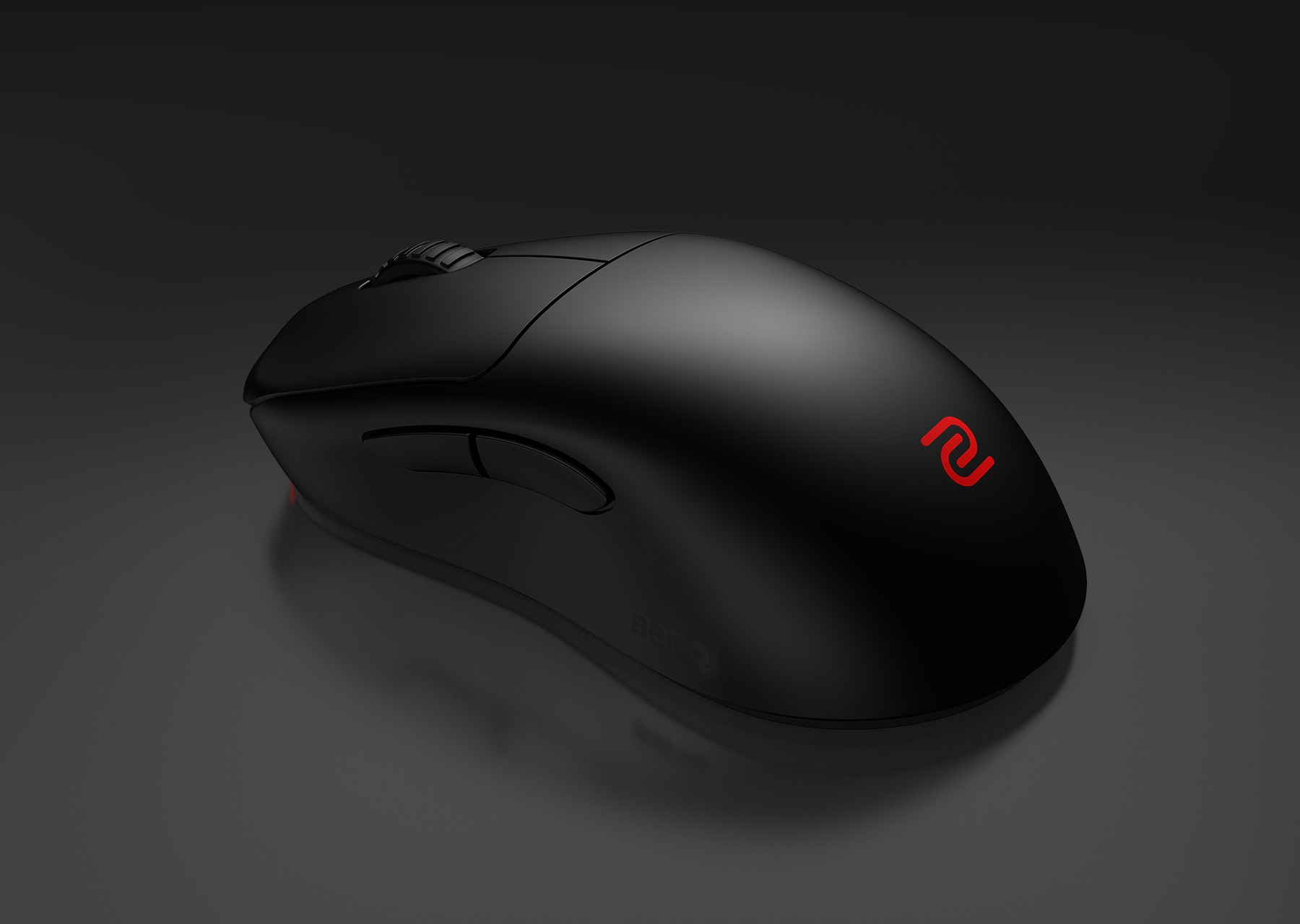
Source: ZOWIE / BenQ (official product image)
ZOWIE announced the EW Version on November 24, and it is the biggest refresh of the brand's esports mice in years. Six models across four classic shape families get 8,000Hz wireless polling, a new click system, a grippier coating, and a receiver that finally does more than sit on your desk. The shapes are the ones ZOWIE players already know by heart. Everything else is new.
What the ZOWIE EW Version Changes
The lineup covers six models: the EC1-EW, EC2-EW, and EC3-EW in the asymmetrical EC family, plus the FK2-EW, ZA13-EW, and U2-EW in the symmetrical families. Sizes run from the large EC1-EW at 129.4mm long down to the small EC3-EW at 118.4mm, and weights sit between 50g and 55g. The FK2-EW is the low, symmetrical shape with a central hump, the ZA13-EW carries a tall rear hump, and the U2-EW is built for claw grip with a tall front. ZOWIE's pitch is simple: the same handling players have used for years, with the internals brought up to date.
The headline change is the polling rate. The EW mice report at up to 8,000Hz over both wired and 2.4GHz wireless connections, which means a position report every 0.125ms instead of every 1ms at the old 1,000Hz standard. Sensitivity runs from 100 to 42,000 DPI, with presets from 400 to 3,200. A firmware setting called Performance Mode targets lower latency, and Motion Sync is included as well. ZOWIE has not named the sensor inside, so that detail stays unconfirmed for now. The full announcement is on ZOWIE's official news page.
8,000Hz Polling, and the Battery Bill That Comes With It
High polling rates are not free, and ZOWIE publishes the battery numbers plainly, which is worth respecting. With Performance Mode off, the EW mice run for 143 hours at 1,000Hz, 93 hours at 2,000Hz, 48 hours at 4,000Hz, and 29 hours at 8,000Hz. With Performance Mode on, those numbers fall to 29 hours at 1,000Hz and 22 hours at 8,000Hz. In practice, that means 8,000Hz is a tournament-day setting, not a leave-it-on-forever setting, and most players will be better served at 1,000Hz or 2,000Hz for daily play.
That trade-off is the honest story of every 8K mouse on the market, and it is why the charging setup matters as much as the sensor. ZOWIE's answer is the new Enhanced Receiver, which doubles as a charging dock, so topping up between sessions takes no extra effort. If battery life matters more than the last fraction of a millisecond, the sensible default is 2,000Hz, and you will not feel the difference in most games. For players comparing options, our best budget gaming mice of 2026 covers what the cheaper end of the market offers, and the Razer DeathAdder V4 Pro review shows what the other big esports mouse of the year does differently.
The Receiver Is the Real Story
The Enhanced Receiver is the part that changes how you use the mouse day to day. It has a built-in display, and DPI, polling rate, lift-off distance, and click response time can all be adjusted directly at the receiver, without opening any software. Hold the receiver for three seconds to enter setup mode, use the scroll wheel to flip through options, and click to confirm. The receiver also works as a pogo-pin charging dock, and its directional antenna is designed to listen toward the mouse while cutting interference from behind, which matters in dense tournament environments full of wireless gear.
That driverless approach is very ZOWIE. The brand has always sold simplicity: plug it in, set it with the buttons, and play. The display receiver keeps that philosophy while adding the one thing the old setup lacked, which is a way to see what you have actually set. Each mouse has seven buttons and a 24-step optical scroll wheel, and the box includes the receiver, a small USB wireless receiver, a USB-C adapter, and a 1.8m cable.
Rhythm Click and Dry-Touch
The EW Version also introduces Rhythm Click, a redesigned click mechanism with an elastic button plate and an angled micro-switch tuned for faster rebound, which ZOWIE says improves shooting rhythm. The other new touch is Dry-Touch, a black matte coating engineered for a drier, non-sticky surface feel with reduced friction. Sweaty hands are the quiet enemy of every esports mouse, and a coating that stays grippy through a long session is a genuine quality-of-life improvement, even if it is not the kind of spec that shows up on a chart.
Taken together, the EW Version looks like ZOWIE catching up on polling rate while keeping what makes the brand different: proven shapes and controls you can reach without opening an app. The Logitech G PRO X3 Superstrike review shows the other direction the market is going, with haptic clicks and heavier software integration. ZOWIE is betting that a chunk of competitive players would rather have a familiar shape and a receiver with a screen.
Price and Availability
Each EW model carries a recommended retail price of 169.99 euros in Europe. The U2-EW, FK2-EW, and EC1-EW arrive in Europe in early December, with the EC2-EW, EC3-EW, and ZA13-EW to follow later. The other models are expected across the EU, the US, and other markets between late December 2026 and March 2027. UK prices and a UK release date are not confirmed yet, and neither is US pricing, so American buyers will have to wait for ZOWIE's regional announcements. The sensor remains unnamed, and final weights for the FK2-EW and ZA13-EW are still listed as approximate in some places, so check the product page before you buy. If your current EC or FK is still going strong, there is no rush. But if you have been waiting for ZOWIE to go 8K without changing the shape in your hand, this is the release you were waiting for.